Introduction
AI is changing how we manage and engage employees. Learn how to use AI to improve workflows, boost productivity, and empower managers with practical, actionable insights.
In This Guide, You'll Discover:
- How AI can streamline processes and save time.
- Practical ways to use AI to support managers and improve employee engagement.
- Real examples of AI in action to drive results.
Download your free guide today and take the first step toward transforming employee engagement with AI.
Introduction
Cutting Through the AI Noise
AI is transforming HR, but its impact is often stalled by a lack of clear strategy and direction. While 50% of employees are using AI, only 12% feel it has meaningfully changed their work (Gallup’s State of the Global Workplace 2026 report). History shows that technological disruption consistently creates new categories of work and increases demand for human talent (New York Times), highlighting the need for a clear strategy in navigating these changes.
For HR leaders, the challenge is to distinguish where AI can deliver real value in an organisation, and what creates clutter. This guide dissects the hype and offers clear, actionable insights on how to effectively harness AI to enhance employee engagement.
Meet the Experts

Alex Williams
Director of Customer Experience, Inpulse
Works hands-on with organisations navigating engagement and change, seeing first-hand what actually drives action

Flo Eynon
Product Manager, Inpulse
Leads product direction at Inpulse, defining what AI tools to build - and what not to based on real-world use and measurable outcomes
"Start With the Problem — Not the Technology. AI is designed to enable people, but to be genuinely useful and scalable it has to solve real problems. The goal is to remove the heavy lifting so people can focus on the high-value, strategic work that actually drives business impact."
The Problem: Navigating the AI Landscape
Many organisations face common pitfalls with AI adoption:
- Overcomplicating processes instead of simplifying. Adding to the already high workload.
- Generic outputs that lack context and nuance.
- Lack of manager buy-in, leading to poor adotpion.
- Operational bottlenecks that AI fails to address.
AI must solve real, specific problems to deliver value.
The Solution: A "Friction-Reset" Operating Model
To maximise AI’s impact, adopt a subtract-first mindset: remove inefficiencies before adding new tools.
The friction-reset operating model is centered on identifying and addressing core operational bottlenecks that drain employee energy and productivity, then using AI to eliminate these obstacles. It emphasises:
- Removing Friction from Workflows: Identify and address systems and processes that cause unnecessary complexity or delays. AI can automate routine tasks, improving efficiency and enabling employees to focus on higher-value work.
- Protecting Manager Capacity: Managers often carry heavy operational loads. By automating repetitive tasks like meeting notes, scheduling, and reporting, AI acts as a “supportive teammate,” freeing up time for managers to focus on leadership and strategy.
- Solving Real Problems: Focus on tangible pain points (e.g., slow data analysis, ineffective communication) instead of chasing trends. AI should improve existing systems, not create new layers of complexity.
This model emphasises efficiency over novelty, creating a leaner, more agile approach to HR transformation. The result is not just better adoption of AI but also sustainable improvements in productivity and employee engagement.
A Practical Framework
Not every use case is worth pursuing, and not every opportunity carries the same level of value, effort, or risk.
The matrix is a strategic tool designed by Inpulse to help leaders decide which AI initiatives to fund, build, or ignore.
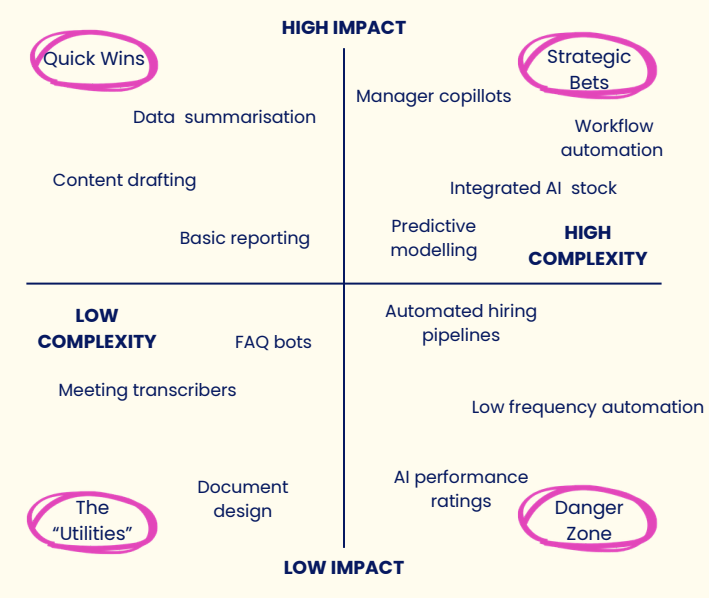
1. The Quick Wins (High Impact / Low Complexity)
Goal: Build momentum and trust.
Why it works: Easy implementation and immediate time-savings for the HR team.
- Data summarisation: Summarising large volumes of data e.g. Inpulse AI summaries for employee feedback, processes hundreds of thousands of datapoints in under a minute.
- Content drafting: Lots of use cases, e.g. internal comms, meeting agendas, job specs, etc.
- Basic reporting: e.g. Auto-generating monthly people reports for leadership rather than manually exporting on pivoting into Excel
2. The Utilities (Low Impact / Low Complexity)
Goal: Incremental efficiency.
Why it works: Good to have for overall efficiency, but they won't "move the needle" on the company's bottom line or employee retention.
- FAQ bots: easy to implement, plug-ins available. E.g. An internal bot that answers "How do I claim my dental expenses?" by linking to the relevant PDF in the employee handbook.
- Meeting transcribers: useful for documentation but doesn't inherently change culture of meetings.
- Document design: AI tools that build presentations or guide. Lack of output control, hard to tailor branding.
3. The Danger Zone (Low Impact / High Complexity)
Avoid these. These drain resources and often create "friction" rather than solving it.
- Automated Hiring Pipelines: Removing humans entirely from the final selection process.
- AI Performance Ratings: Large enterprises are using AI to track digital activity (e.g. emails, idle time) as a proxy for performance - driving "performance theatre" where employees optimise for visible metrics over the quality and strategic value of their work.
- Low Frequency Automation: Spending high resources to automate tasks
4. The Strategic Bets (High Impact / High Complexity)
Goal: Long-term transformation of the employee experience.
Why it works: These are hard to do but create a massive competitive advantage and deeply improve engagement.
- Manager co-pilots: real-time guidance to help managers make better decisions e.g. Inpulse's suggested actions.
- Workflow automation: Something we're working on at Inpulse. Redesigning entire end-to-end processes using AI agents, e.g. survey set up, data cleansing + sendout.
- Predictive modelling: e.g. forecasting future workforce risks and trends to inform decision making.
- Integrated AI stack: suitable for bigger orgs e.g. Unilever (Europe) reduced time-to-hire from 4 months to 4 weeks using an AI-powered hiring stack (it integrates AI games for skill assessment with automated video interviews), saving £1M+ in recruiter time while increasing diversity by 16%.
Step-by-Step Recommendations: How to Implement AI Effectively
Once you've understood the friction reset-model, here's how to put it into action with AI:
1. Identify and Remove Daily Friction
Start by targeting operational bottlenecks that impact employee energy and productivity. Research consistently shows that inefficiencies in workflows and daily tasks are a major contributor to disengagement.
For example, a study by Gallup found that employees who spend more time on administrative tasks are significantly less engaged, impacting productivity and morale. AI can be used to streamline workflows and improve efficiency in these areas:
- Streamlining processes:
Identify inefficient systems, outdated tools or manual workflows and automate them with AI. - Reducing managerial burden:
Automate routine administrative tasks, allowing managers to focus on leadership and team development. - Balancing workloads:
Use AI to monitor workload distribution and ensure it aligns with recovery time, preventing burnout and creating a healthier work environment.
2. Implement AI Tools that Protect Manager Capacity
Managers often get caught up in urgent tasks, limiting time for strategic leadership. Deploying AI tools that automate routine tasks and provide data-driven insights enables managers to shift from reactive to proactive, focusing on high-value work like team development and decisionmaking. The key categories of tools include:
- Workflow automation:
Automate tasks like meeting transcriptions, content creation, and reporting to save time. - Manager copilots:
AI tools that provide real-time feedback and coaching, helping managers make decisions faster. They act as an internal consultant and sounding board for the manager. - Data analysis:
Use AI to rapidly process qualitative data, summarising feedback into actionable insights that save managers time. - Predicitive analytics:
Leverage predictive tools to forecast employee turnover, enabling managers to take proactive action before issues arise.
These tools are about restoring manager capacity, not just
speeding up overloaded systems.
3. Integrate AI into Daily Workflows
Embed AI into the moments where work actually happens - not as a separate tool, but as part of day-to-day decisionmaking and management. As highlighted in McKinsey Rewired, organisations that win prioritise speed, adaptability, and continuous learning over rigid planning cycles. Here’s how:
- In-the-flow insights for managers:
Surface AI-driven insights directly where managers are already working (e.g. dashboards, email summaries, collaboration tools), so they can quickly understand what’s happening in their team without needing to interpret raw data. - AI recommended actions:
Move beyond reporting by embedding suggested actions into the workflow - giving managers clear, practical next steps based on their team’s feedback, rather than expecting them to figure it out themselves.
- Automated summaries & prioritisation:
Use AI to distil large volumes of feedback into concise summaries, highlighting what matters most and where to focus - reducing analysis time and enabling faster decisions. - Real-time nudges & prompts:
Integrate lightweight prompts into daily tools (e.g. reminders to recognise good work, follow up on feedback, or check in with teams) to reinforce consistent management behaviours. - Closing the loop, automatically:
Integrate lightweight prompts into daily tools (e.g. reminders to recognise good work, follow up on feedback, or check in with teams) to reinforce consistent management behaviours.
If AI lives outside the workflow, it creates noise - if it’s embedded, it drives action.
What Comes Next: The Next Phase of AI in Employee Engagement
AI in employee engagement is moving beyond isolated tools and into something more embedded, predictive, and personalised. The next phase isn’t about more AI - it’s about better integration, smarter application, and greater impact on day-to-day work.
Here are three shifts HR leaders should be preparing for:
1. Personalisation at scale
AI will enable organisations to move away from onesize-fits-all approaches and towards highly tailored employee experiences.
- Personalised development: AI will map individual skill gaps against future roles and recommend targeted learning pathways
- Life-stage driven support: Benefits, communications, and support will adapt based on employee context (e.g. career stage, personal circumstances)
- More relevant engagement strategies: Feedback, actions, and interventions will become more targeted - increasing impact and reducing noise
The shift: from broad programmes → individualised experiences at scale
2. Always -on employee intelligence
Employee listening will evolve from periodic surveys to always-on, intelligent systems.
- Continuous feedback loops become the norm, not the exception
- AI will connect multiple data sources (surveys, behaviours, workflows) to provide a live view of engagement
- Organisations move from reacting to problems → anticipating them before they escalate
The shift: from hindsight → real-time, predictive insight
3. Operationalising AI in the Workplace
AI is moving from standalone tools to embedded, end-to-end workflows
- AI agents handling entire processes (e.g. survey setup → analysis → action → follow-up)
- Seamless integration into existing systems (HRIS, collaboration tools, engagement platforms)
- A move towards hybrid human–AI teams, where AI acts as a support layer rather than a separate system
The shift: from disconnected tools → AI as part of how work gets done
What this means for HR leaders
The organisations that will get ahead are not the ones adopting the most AI tools, but the ones that:
- Focus on integration over experimentation
- Build manager capability alongside AI capability
- Use AI to increase clarity, speed, and confidence in decision-making
Because ultimately, the goal isn’t more technology… it’s better, faster, more human execution at scale.
Putting it into Practice: LQ Culture
Beyond the technical tools themselves, the secret to maintaining high engagement and active participation during an AI rollout lies in how effectively your team is empowered to navigate change—a concept known as Learning Quotient (LQ).
A high Learning Quotient (LQ) is the ability to “learn, unlearn, and relearn” to drive progress. For organisations, it’s about fostering continuous learning at a collective level, empowering employees to adapt quickly and drive growth together.
Employees with high LQ can inspire peers, multiplying the impact of their learning across the company.
This mindset is crucial in the face of rapid tech and AI transformations, as it supports:
- Rapid Adaptation: Because the technology landscape is changing so rapidly, employees often find themselves using completely new tools without formal training. A high LQ enables them to quickly adapt and figure out how to leverage these tools effectively.
- Agility through Unlearning: A crucial component of a high LQ is the cognitive capacity to not just learn, but to “unlearn and relearn.” This agility ensures an organisation can shed outdated practices or legacy workflows to fully embrace modern capabilities.
- Competitive Advantage: The companies that will ultimately win in the AI era are the “fastest learners.” Organisations that can learn and apply technology quickly extract the most value and gain a strategic edge.
To truly harness the power of AI, organisations must cultivate a high LQ culture and integrate it into their talent strategy. Companies should prioritise LQ alongside IQ and EQ in their hiring practices, ensuring that leaders promote individuals who can quickly adapt, unlearn outdated methods, and drive continuous improvement in an ever-evolving landscape.
Conclusion: the bottom line
AI’s true value for enhancing the employee experience lies in removing friction, streamlining workflows, and restoring manager capacity.
Using AI to achieve these outcomes can have a significant impact on employee engagement. However, its effectiveness goes beyond technology; it also requires fostering a culture of continuous learning and adaptability, which is where a high Learning Quotient (LQ) comes in.
To make AI work effectively and sustainably:
- Identify and remove friction in existing workflows.
- Deploy AI tools that empower managers to focus on leadership and strategy.
- Integrate AI directly into daily operations for seamless, continuous improvement.
- Use predictive insights to act on emerging issues before they escalate.
By applying AI through the friction-reset model, HR leaders can optimise both technology and leadership, driving engagement, performance, and long-term organisational success.


